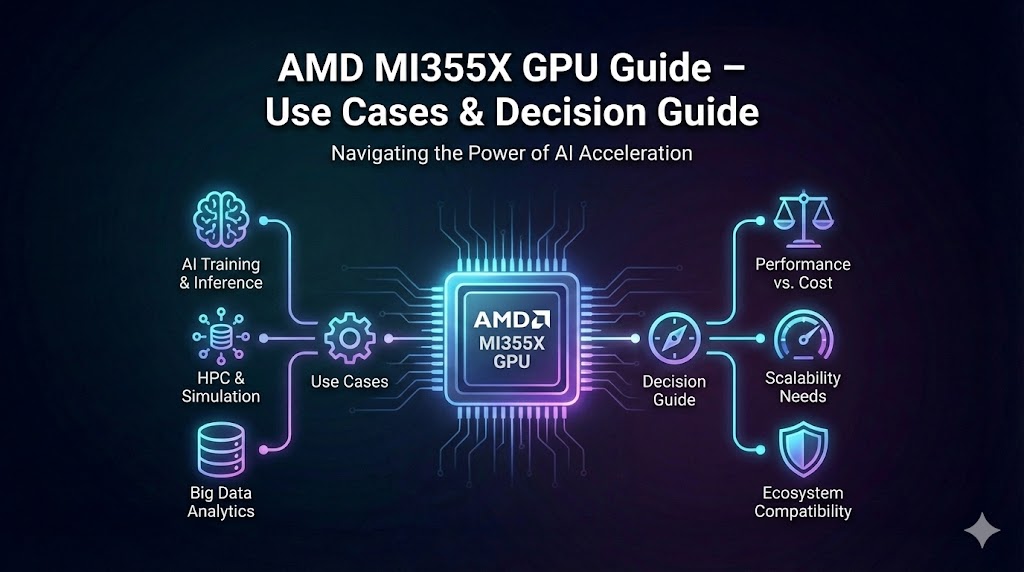
Quick Summary: What makes the AMD MI355X GPU stand out for today’s generative‑AI and HPC workloads? In short, it offers massive on‑chip memory, new low‑precision compute engines, and an open software ecosystem that together unlock large‑language‑model (LLM) training and inference at lower cost. With 288 GB of HBM3E memory and 8 TB/s bandwidth, the MI355X can run models exceeding 500 billion parameters without partitioning them across multiple boards. It also delivers up to 4× generational performance over its predecessor and a 35× leap in inference throughput, while new FP4 and FP6 datatypes reduce the energy and cost per token. In this guide you’ll learn how MI355X is engineered, what workloads it excels at, and how to integrate it into a modern AI pipeline using Clarifai’s compute orchestration and local‑runner tools.
Large language models continue to grow in size and complexity. Competitive GPUs have been squeezed by two conflicting pressures: more memory to fit bigger context windows and higher compute density for faster throughput. AMD’s MI355X addresses the memory side head‑on, employing ten HBM3E stacks plus a large on‑die Infinity Cache to deliver 50 % more capacity and 51 % more bandwidth than the MI300X. It is also part of a flexible Universal Baseboard (UBB 2.0) that supports both air‑ and liquid‑cooled servers and scales to 128 GPUs for more than 1.3 exaFLOPS of low‑precision compute. Clarifai’s platform complements this hardware by allowing you to orchestrate MI355X clusters across cloud, on‑prem or edge environments and even run models locally using AI Runners. Together, these technologies provide a bridge from early prototyping to production‑scale AI.
The MI355X is built on AMD’s CDNA 4 architecture, a chiplet‑based design that marries multiple compute dies, memory stacks and a high‑bandwidth interconnect. Each GPU includes eight compute chiplets (XCDs), yielding 16,384 stream processors and 1,024 matrix cores to accelerate tensor operations. These cores support native FP4 and FP6 datatypes that pack more operations per watt than traditional FP16 or FP32 arithmetic. A high‑level spec sheet looks like this:
|
Component |
Highlights |
|
Compute Units & Cores |
256 compute units and 16,384 stream processors; 1,024 matrix cores enable over 10 petaFLOPS of FP4/FP6 performance. |
|
Clock Speeds |
Up to 2.4 GHz engine clock, which can be sustained thanks to redesigned cooling and power delivery. |
|
Memory |
288 GB HBM3E across 10 stacks with 8 TB/s bandwidth; a 256 MB Infinity Cache smooths memory accesses. |
|
Interconnect |
Seven Infinity Fabric links, each delivering 153 GB/s for a total peer‑to‑peer bandwidth of 1.075 TB/s. |
|
Board Power |
1.4 kW typical board power; available in air‑cooled and liquid‑cooled variants. |
|
Precision Support |
FP4, FP6, FP8, BF16, FP16, FP32 and FP64; FP64 throughput reaches 78.6 TFLOPS, making the card suitable for HPC workloads. |
|
Additional Features |
Robust RAS and ECC, support for secure boot and platform‑level attestation, plus a flexible UBB 2.0 baseboard that pools memory across up to eight GPUs. |
Behind these numbers are architectural innovations that differentiate the MI355X:
Taken together, these features mean the MI355X is not simply a faster version of its predecessor – it is architected to fit bigger models into fewer GPUs while delivering competitive compute density. The trade‑off is power: a 1.4 kW thermal design requires robust cooling, but direct liquid‑cooling can lower power consumption by up to 40 % and reduce total cost of ownership (TCO) by 20 %.
One of the most common questions about any accelerator is how it performs relative to competitors and its own predecessors. AMD positions the MI355X as both a generational leap and a cost‑effective alternative to other high‑end GPUs.
According to AMD’s benchmarking, the MI355X delivers up to 4× peak theoretical performance compared with the MI300X. In real workloads this translates to:
From a precision standpoint, FP4 mode alone yields a 2.7× increase in tokens per second over MI325X on the Llama 2 – 70B server benchmark. AMD’s structured pruning further improves throughput: pruning 21 % of Llama 3.1 – 405B’s layers leads to an 82 % throughput gain, while a 33 % pruned model delivers up to 90 % faster inference with no accuracy loss. In multi‑node setups, a 4‑node MI355X cluster achieves 3.4× the tokens per second of a previous 4‑node MI300X system, and an 8‑node cluster scales nearly linearly. These results show that the MI355X scales both within a card and across nodes without suffering from communication bottlenecks.
Independent analyses comparing MI355X to the leading alternative GPU highlight nuanced trade‑offs. While the competitor often boasts higher peak compute density, the MI355X’s memory capacity and FP6 throughput enable 1.3–2× higher throughput on large models such as Llama 3.1 – 405B and DeepSeek‑R1. Analysts at BaCloud estimate that MI355X’s FP6 throughput is over double that of the competitor because AMD allocates more die area to low‑precision units. Furthermore, the 288 GB HBM3E allows MI355X to run bigger models without splitting them, whereas the competitor’s 192 GB memory forces pipeline or model parallelism, reducing effective tokens‑per‑watt.
AMD’s distributed inference research shows that MI355X shines when concurrency is high. The ATOM inference engine, developed as part of ROCm 7, fuses memory‑bound kernels and manages key/value caches efficiently. As concurrency grows, MI355X maintains higher throughput per GPU than the competition and scales well across multiple nodes. Multi‑node experiments show smooth scaling up to 8 GPUs for latency‑sensitive workloads.
In LLM and agentic‑AI tasks, memory limits can be more restrictive than compute. Each additional context token or expert layer requires more memory to store activations and KV caches. The MI355X addresses this by providing 288 GB of HBM3E plus a 256 MB Infinity Cache, enabling both training and inference of 520 billion‑parameter models on a single board. This capacity increase has several practical benefits:
The UBB 2.0 design pools up to 2.3 TB of HBM3E when eight MI355X boards are installed. Each board communicates through Infinity Fabric links with 153 GB/s per link, ensuring quick peer‑to‑peer transfers and memory coherence. In practice this means that an 8‑GPU cluster can train or infer models well beyond one trillion parameters without resorting to host memory or NVMe offload. Cloud providers like Vultr and TensorWave emphasize this capability as a reason for early adoption.
The MI355X is particularly well‑suited for large language models, especially those exceeding 70 billion parameters. With its massive memory, you can fine‑tune a 400B‑parameter model for domain adaptation without pipeline parallelism. For inference, you can serve models like Llama 3.1 – 405B or Mixtral with fewer GPUs, leading to lower latency and cost. This is especially important for agentic AI systems where context and memory usage scale with the number of agents interacting.
Creative examples include:
Beyond AI, the MI355X’s 78.6 TFLOPS FP64 performance makes it suitable for computational physics, fluid dynamics and finite‑element analysis. Engineers can run large‐scale simulations, such as climate or structural models, where memory bandwidth and capacity are crucial. The Infinity Cache helps smooth memory access patterns in sparse matrix solves, while the large HBM memory holds entire matrices.
Some workloads blend AI and HPC. For example, graph neural networks (GNNs) for drug discovery require both dense compute and large memory footprints to hold molecular graphs. The MI355X’s memory can store graphs with millions of nodes, while its tensor cores accelerate message passing. Similarly, finite element models that incorporate neural network surrogates benefit from the GPU’s ability to handle FP64 and FP4 operations in the same pipeline.
Not every application requires a multi‑hundred‑billion‑parameter model. With Clarifai’s Reasoning Engine, developers can choose smaller models (e.g., 2–7 B parameters) and still benefit from low‑precision inference. Clarifai’s blog notes that small language models deliver low‑latency, cost‑efficient inference when paired with the Reasoning Engine, Compute Orchestration and Local Runners. Teams can spin up serverless endpoints for these models or use Local Runners to serve them from local hardware with minimal overhead.
Hardware is only half of the story; the software ecosystem determines how accessible performance is. AMD ships the MI355X with ROCm 7, an open‑source platform comprising drivers, compilers, libraries and containerized environments. Key components include:
On top of ROCm, software partners have built tools that exploit MI355X’s architecture:
Clarifai extends these capabilities by offering Compute Orchestration, a service that lets users deploy any AI model on any infrastructure with serverless autoscaling. The documentation explains that this platform handles containerization, model packing, time slicing and autoscaling so that you can run models on public cloud, dedicated SaaS, self‑managed VPC or on‑premises. This means you can provision MI355X instances in a cloud or connect your own MI355X hardware and let Clarifai handle scheduling and scaling.
For developers who prefer local experimentation, Local Runners provide a way to expose locally running models via a secure, public API. You install Clarifai’s CLI, start a local runner and then the model becomes accessible through Clarifai’s workflows and pipelines. This feature is ideal for testing MI355X‑hosted models before deploying them at scale.
AMD partners such as Supermicro and Vultr offer MI355X servers in various configurations. Supermicro’s 10U air‑cooled chassis houses eight MI355X GPUs and claims a 4× generational compute improvement and a 35× inference leap. Liquid‑cooled variants further reduce power consumption by up to 40 % and lower TCO by 20 %. On the cloud, providers like Vultr and TensorWave sell dedicated MI355X nodes, highlighting cost efficiency and open‑source flexibility.
The MI355X’s 1.4 kW TDP is higher than that of its predecessor, reflecting its larger memory and compute units. Data centers must therefore provision adequate power and cooling. Liquid cooling is recommended for dense deployments, where it not only manages heat but also reduces overall energy consumption. Organizations should evaluate whether their existing power budgets can support large MI355X clusters or whether a smaller number of cards will suffice due to the memory advantage.
From a financial perspective, the MI355X often lowers cost per query because fewer GPUs are needed to serve a model. AMD’s analysis reports 40 % lower tokens‑per‑dollar for generative AI inference compared to the leading competitor. Cloud providers offering MI355X compute cite similar savings. Liquid cooling further improves tokens per watt by reducing energy waste.
Selecting the right accelerator for your workload involves balancing memory, compute and operational constraints. Below is a decision framework tailored to the MI355X and Clarifai’s platform.
The MI355X arrives at a dynamic moment for AI hardware. Several trends will shape its relevance and the broader ecosystem in 2026 and beyond.
Low‑precision arithmetic is gaining momentum because it improves energy efficiency without sacrificing accuracy. Research across the industry shows that FP4 inference can reduce energy consumption by 25–50× compared with FP16 while maintaining near‑identical accuracy. As frameworks mature, we will see even more adoption of FP4/FP6, and new algorithms will emerge to train directly in these formats.
Structured pruning will be a major lever for deploying enormous models within practical budgets. Academic research (e.g., the CFSP framework) demonstrates that coarse‑to‑fine activation‑based pruning can achieve hardware‑friendly sparsity and maintain accuracy. Industry benchmarks show that pairing structured pruning with low‑precision inference yields 90 % throughput gains. Expect pruning libraries to become standard in AI toolchains.
Future GPUs will continue pushing memory capacity. AMD’s roadmap includes HBM4 with 432 GB and 19.6 TB/s bandwidth. Combined with faster interconnects, this will allow training trillion‑parameter models on fewer GPUs. Multi‑die packaging and chiplet architectures (as seen in MI355X) will become the norm.
As data‑sovereignty regulations tighten, edge computing will grow. Clarifai’s Local Runners and agentic AI features illustrate a move toward local‑first development, where models run on laptops or on‑premises clusters and then scale to the cloud as needed. The MI355X’s large memory makes it a candidate for edge servers handling complex inference locally.
With more powerful models come greater responsibility. The Clarifai Industry Guide on AI trends notes that enterprises must incorporate governance, risk and trust frameworks alongside technical innovation. The MI355X’s secure boot and ECC memory support this requirement, but software policies and auditing tools remain essential.
Q1. Can the MI355X train models larger than 500 billion parameters on a single card? Yes. With 288 GB of HBM3E memory, it can handle models up to 520 B parameters. Larger models can be trained on multi‑GPU clusters thanks to the 1.075 TB/s Infinity Fabric interconnect.
Q2. How does MI355X’s FP6 compare to other low‑precision formats? AMD’s FP6 delivers more than double the throughput of the leading competitor’s low‑precision format because the MI355X allocates more silicon to matrix cores. FP6 provides a balance between accuracy and efficiency for both training and inference.
Q3. Is the MI355X energy‑efficient given its 1.4 kW power draw? Although the card consumes more power than its predecessor, its tokens‑per‑watt is up to 30 % better thanks to FP4/FP6 efficiency and large memory that reduces the number of GPUs required. Liquid cooling can further reduce energy consumption.
Q4. Can I run my own models locally using Clarifai and MI355X? Absolutely. Clarifai’s Local Runners allow you to expose a model running on your local MI355X hardware through a secure API. This is ideal for development or sensitive data scenarios.
Q5. Do I need to rewrite my CUDA code to run on MI355X? Yes, some porting effort is necessary because MI355X uses ROCm. However, tools like Modular’s MAX engine and ROCm‑compatible versions of PyTorch make the transition smoother.
Q6. Does Clarifai support multi‑cloud or hybrid deployments with MI355X? Yes. Clarifai’s Compute Orchestration supports deployments across multiple clouds, self‑managed VPCs and on‑prem environments. This lets you combine MI355X hardware with other accelerators as needed.
The AMD MI355X represents a pivotal shift in GPU design—one that prioritizes memory capacity and energy‑efficient precision alongside compute density. Its 288 GB HBM3E memory and 8 TB/s bandwidth enable single‑GPU execution of models that previously required multi‑board clusters. Paired with FP4/FP6 modes, structured pruning and a robust Infinity Fabric interconnect, it delivers impressive throughput and tokens‑per‑watt improvements. When combined with Clarifai’s Compute Orchestration and Local Runners, organizations can seamlessly transition from local experimentation to scalable, multi‑site deployments.
Looking ahead, trends such as pruning‑aware optimization, HBM4 memory, mixed‑precision training and edge‑first inference will shape the next generation of AI hardware and software. By adopting MI355X today and integrating it with Clarifai’s platform, teams gain experience with these technologies and position themselves to capitalize on future advancements. The decision framework provided in this guide helps you weigh memory, compute and deployment considerations so that you can choose the right hardware for your AI ambitions. In a rapidly evolving landscape, memory‑rich, open‑ecosystem GPUs like MI355X—paired with flexible platforms like Clarifai—offer a compelling path toward scalable, responsible and cost‑effective AI.