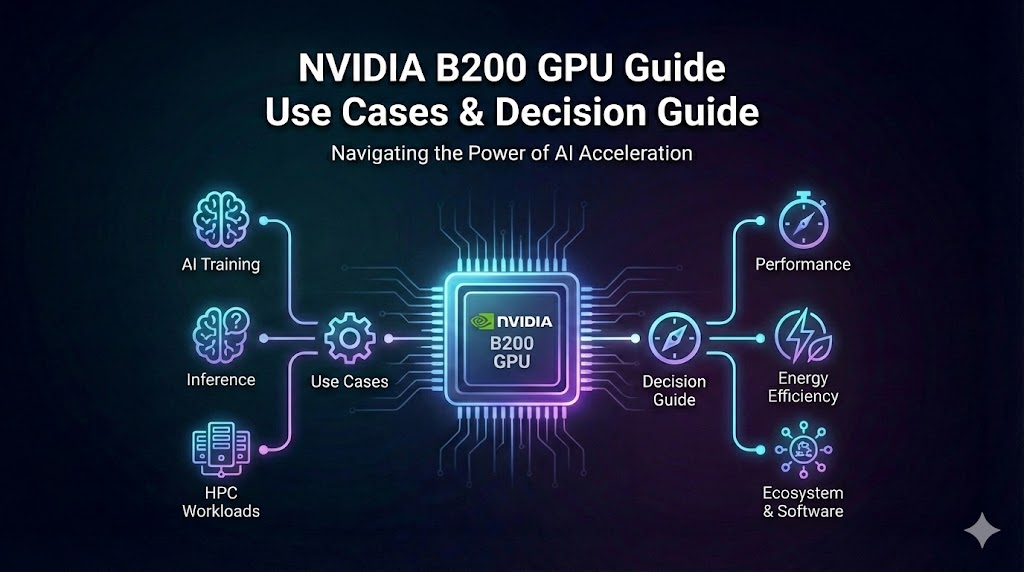
The rapid growth of large language models (LLMs), multi‑modal architectures and generative AI has created an insatiable demand for compute. NVIDIA’s Blackwell B200 GPU sits at the heart of this new era. Announced at GTC 2024, this dual‑die accelerator packs 208 billion transistors, 192 GB of HBM3e memory and a 1 TB/s on‑package interconnect. It introduces fifth‑generation Tensor Cores supporting FP4, FP6 and FP8 precision with two‑times the throughput of Hopper for dense matrix operations. Combined with NVLink 5 providing 1.8 TB/s of inter‑GPU bandwidth, the B200 delivers a step change in performance—up to 4× faster training and 30× faster inference compared with H100 for long‑context models. Jensen Huang described Blackwell as “the world’s most powerful chip”, and early benchmarks show it offers 42 % better energy efficiency than its predecessor.
|
Key question |
AI overview answer |
|
What is the NVIDIA B200? |
The B200 is NVIDIA’s flagship Blackwell GPU with dual chiplets, 208 billion transistors and 192 GB HBM3e memory. It introduces FP4 tensor cores, second‑generation Transformer Engine and NVLink 5 interconnect. |
|
Why does it matter for AI? |
It delivers 4× faster training and 30× faster inference vs H100, enabling LLMs with longer context windows and mixture‑of‑experts (MoE) architectures. Its FP4 precision reduces energy consumption and memory footprint. |
|
Who needs it? |
Anyone building or fine‑tuning large language models, multi‑modal AI, computer vision, scientific simulations or demanding inference workloads. It’s ideal for research labs, AI companies and enterprises adopting generative AI. |
|
How to access it? |
Through on‑prem servers, GPU clouds and compute platforms such as Clarifai’s compute orchestration—which offers pay‑as‑you‑go access, model inference and local runners for building AI workflows. |
The sections below break down the B200’s architecture, real‑world use cases, model recommendations and procurement strategies. Each section includes expert insights summarizing opinions from GPU architects, researchers and industry leaders, and Clarifai tips on how to harness the hardware effectively.
Answer: The B200 uses a dual‑chiplet design where two reticle‑limited dies are connected by a 10 TB/s chip‑to‑chip interconnect. This effectively doubles the compute density within the SXM5 socket. Its 5th‑generation Tensor Cores add support for FP4, a low‑precision format that cuts memory usage by up to 3.5× and improves energy efficiency 25‑50×. Shared Memory clusters offer 228 KB per streaming multiprocessor (SM) with 64 concurrent warps to increase utilization. A second‑generation Transformer Engine introduces tensor memory for fast micro‑scheduling, CTA pairs for efficient pipelining and a decompression engine to accelerate I/O.
Expert Insights:
The B200’s architecture introduces several innovations:
Creative Example: Imagine training a 70B‑parameter language model. On Hopper, the model would require multiple GPUs with 80 GB each, saturating memory and incurring heavy recomputation. The B200’s 192 GB HBM3e means the model fits into fewer GPUs. Combined with FP4 precision, memory footprints drop further, enabling more tokens per batch and faster training. This illustrates how architecture innovations directly translate to developer productivity.
Answer: The B200 excels in training and fine‑tuning large language models, reinforcement learning, retrieval‑augmented generation (RAG), multi‑modal models, and high‑performance computing (HPC).
Expert Insights:
Clarifai’s Reasoning Engine leverages B200 GPUs to run complex multi‑model pipelines. Customers can perform Retrieval‑Augmented Generation by pairing Clarifai’s vector search with B200‑powered LLMs. Clarifai’s compute orchestration automatically assigns B200s for training jobs and scales down to cost‑efficient A100s for inference, maximizing resource utilization.
Answer: Models with large parameter counts, long context windows or mixture‑of‑experts architectures gain the most from the B200. Popular open‑source models include LLaMA 3 70B, DeepSeek‑R1, GPT‑OSS 120B, Kimi K2 and Mistral Large 3. These models often support 128k‑token contexts, require >100 GB of GPU memory and benefit from FP4 inference.
Clarifai’s Model Zoo includes pre‑optimized versions of major LLMs that run out‑of‑the‑box on B200. Through the compute orchestration API, developers can deploy vLLM or SGLang servers backed by B200 or automatically fall back to H100/A100 depending on availability. Clarifai also provides serverless containers for custom models so you can scale inference without worrying about GPU management. Local Runners allow you to fine‑tune models locally using smaller GPUs and then scale to B200 for full‑scale training.
Expert Insights:
The B200 offers the most memory, bandwidth and energy efficiency among current Nvidia GPUs, with performance advantages even when compared with competitor accelerators like AMD MI300X. The table below summarizes the key differences.
|
Metric |
H100 |
H200 |
B200 |
AMD MI300X |
|
FP4/FP8 performance (dense) |
NA / 4.7 PF |
4.7 PF |
9 PF |
~7 PF |
|
Memory |
80 GB HBM3 |
141 GB HBM3e |
192 GB HBM3e |
192 GB HBM3e |
|
Bandwidth |
3.35 TB/s |
4.8 TB/s |
8 TB/s |
5.3 TB/s |
|
NVLink bandwidth per GPU |
900 GB/s |
1.6 TB/s |
1.8 TB/s |
N/A |
|
Thermal Design Power (TDP) |
700 W |
700 W |
1,000 W |
700 W |
|
Pricing (cloud cost) |
~$2.4/hr |
~$3.1/hr |
~$5.9/hr |
~$5.2/hr |
|
Availability (2025) |
Widespread |
mid‑2024 |
limited 2025 |
available 2024 |
Key takeaways:
Expert Insights:
Suppose you’re running a chatbot using a 70 B‑parameter model with a 64k‑token context. On an H200, the model barely fits into 141 GB of memory, requiring off‑chip memory paging and resulting in 2 tokens per second. On a single B200 with 192 GB memory and FP4 quantization, you process 60 k tokens per second. With Clarifai’s compute orchestration, you can launch multiple B200 instances and achieve interactive, low‑latency conversations.
Answer: There are several ways to access B200 hardware:
Expert Insights:
Signing up with Clarifai is straightforward:
Answer: Use the following decision framework:
Expert Insights:
DeepSeek‑R1 is a mixture‑of‑experts model with eight experts. Running on a DGX with eight B200 GPUs, it achieved 30 k tokens per second and enabled training in half the time of H100. The model leveraged FP4 and NVLink 5 for expert routing, reducing cost per token by 90 %. This performance would have been impossible on previous architectures.
These models use dynamic sparsity and long context windows. Running on GB200 NVL72 racks, they delivered 10× faster inference and one‑tenth cost per token compared with H100 clusters. The mixture‑of‑experts design allowed scaling to 15 or more experts, each mapped to a GPU. The B200’s memory ensured that each expert’s parameters remained local, avoiding cross‑device communication.
Researchers in climate modeling used B200 GPUs to run 1 km‑resolution global climate simulations previously limited by memory. The 8 TB/s memory bandwidth allowed them to compute 1,024 time steps per hour, more than doubling throughput relative to H100. Similarly, computational chemists reported a 1.5× reduction in time‑to‑solution for ab‑initio molecular dynamics due to increased FP64 performance.
An e‑commerce company used Clarifai’s Reasoning Engine to build a product recommendation chatbot. By migrating from H100 to B200, the company cut response times from 2 seconds to 80 milliseconds and reduced GPU hours by 55 % through FP4 quantization. Clarifai’s compute orchestration automatically scaled B200 instances during traffic spikes and shifted to cheaper A100 nodes during off‑peak hours, saving cost without sacrificing quality.
Think of the B200 cluster as an AI furnace. Each GPU draws 1 kW, equivalent to a toaster oven. A 72‑GPU rack therefore emits roughly 72 kW—like running dozens of ovens in a single room. Without liquid cooling, components overheat quickly. Clarifai’s hosted solutions hide this complexity from developers; they maintain liquid‑cooled data centers, letting you harness B200 power without building your own furnace.
Answer: The B200 is the first of the Blackwell family, and NVIDIA’s roadmap includes B300 (Blackwell Ultra) and future Vera/Rubin GPUs, promising even more memory, bandwidth and compute.
The upcoming B300 boosts per‑GPU memory to 288 GB HBM3e—a 50 % increase over B200—by using twelve‑high stacks of DRAM. It also provides 50 % more FP4 performance (~15 PFLOPS). Although NVLink bandwidth remains 1.8 TB/s, the extra memory and clock speed improvements make B300 ideal for planetary‑scale models. However, it raises TDP to 1,100 W, demanding even more robust cooling.
NVIDIA’s roadmap extends beyond Blackwell. The “Vera” CPU will double NVLink C2C bandwidth to 1.8 TB/s, and Rubin GPUs (likely 2026–27) will feature 288 GB of HBM4 with 13 TB/s bandwidth. The Rubin Ultra GPU may integrate four chiplets in an SXM8 socket with 100 PFLOPS FP4 performance and 1 TB of HBM4E. Rack‑scale VR300 NVL576 systems could deliver 3.6 exaflops of FP4 inference and 1.2 exaflops of FP8 training. These systems will require 3.6 TB/s NVLink 7 interconnects.
Expert Insights:
Clarifai is building support for B300 and future GPUs. Their platform automatically adapts to new architectures; when B300 becomes available, Clarifai users will enjoy larger context windows and faster training without code changes. The Reasoning Engine will also integrate Vera/Rubin chips to accelerate multi‑model pipelines.
A: Yes—provided your code uses CUDA‑standard APIs. However, you must upgrade to CUDA 12.4+ and cuDNN 9. Libraries like PyTorch and TensorFlow already support B200. Clarifai abstracts these requirements through its orchestration.
A: No. Unlike A100, the B200 does not implement MIG partitioning due to its dual‑die design. Multi‑tenancy is instead achieved at the rack level via NVSwitch and virtualization.
A: Each B200 has a 1 kW TDP. You must provide liquid cooling to maintain safe operating temperatures. Clarifai handles this at the data center level.
A: Specialized GPU clouds, compute marketplaces and Clarifai all offer B200 access. Due to demand, supply may be limited; Clarifai’s reserved tier ensures capacity for long‑term projects.
A: The Reasoning Engine connects LLMs, vision models and data sources. It uses B200 GPUs to run inference and training pipelines, orchestrating compute, memory and tasks automatically. This eliminates manual provisioning and ensures models run on the optimal GPU type. It also integrates vector search, workflow orchestration and prompt engineering tools.
A: If your workloads demand >192 GB of memory or maximum FP4 performance, waiting for B300 may be worthwhile. However, the B300’s increased power consumption and limited early supply mean many users will adopt B200 now and upgrade later. Clarifai’s platform lets you transition seamlessly as new GPUs become available.
The NVIDIA B200 marks a pivotal step in the evolution of AI hardware. Its dual‑chiplet architecture, FP4 Tensor Cores and massive memory bandwidth deliver unprecedented performance, enabling 4× faster training and 30× faster inference compared with prior generations. Real‑world deployments—from DeepSeek‑R1 to Mistral Large 3 and scientific simulations—showcase tangible productivity gains.
Looking ahead, the B300 and future Rubin GPUs promise even larger memory pools and exascale performance. Staying current with this hardware requires careful planning around power, cooling and software compatibility, but compute orchestration platforms like Clarifai abstract much of this complexity. By leveraging Clarifai’s Reasoning Engine, developers can focus on innovating with models rather than managing infrastructure. With the B200 and its successors, the horizon for generative AI and reasoning engines is expanding faster than ever.