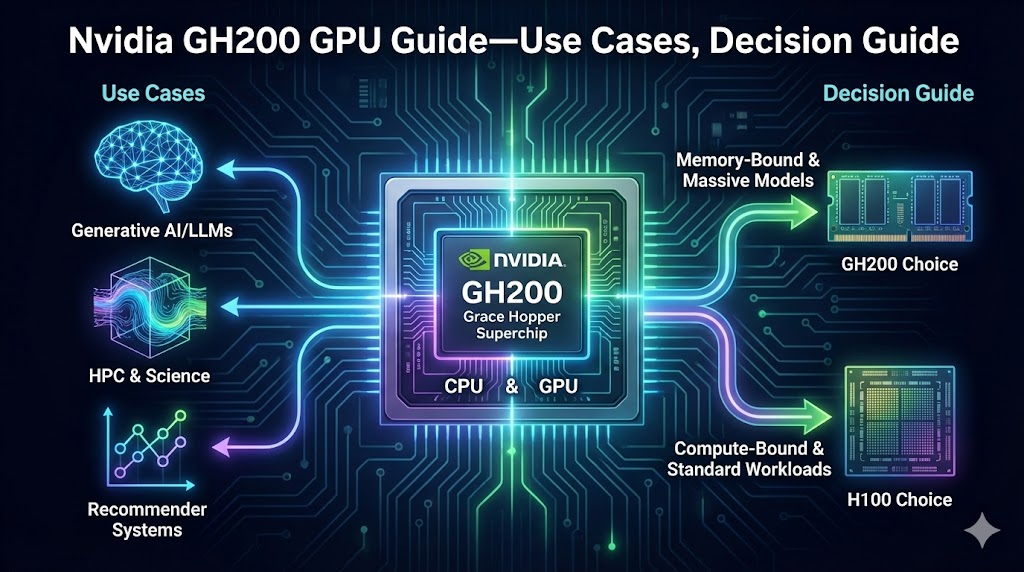
Quick Summary: What is the Nvidia GH200 and why does it matter in 2026? – The Nvidia GH200 is a hybrid superchip that merges a 72‑core Arm CPU (Grace) with a Hopper/H200 GPU using NVLink‑C2C. This integration creates up to 624 GB of unified memory accessible to both CPU and GPU, enabling memory‑bound AI workloads like long‑context LLMs, retrieval‑augmented generation (RAG) and exascale simulations. In 2026, as models grow larger and more complex, the GH200’s memory‑centric design delivers performance and cost efficiency not achievable with traditional GPU cards. Clarifai offers enterprise‑grade GH200 hosting with smart autoscaling and cross‑cloud orchestration, making this technology accessible for developers and businesses.
Artificial intelligence is evolving at breakneck speed. Model sizes are increasing from millions to trillions of parameters, and generative applications such as retrieval‑augmented chatbots and video synthesis require huge key–value caches and embeddings. Traditional GPUs like the A100 or H100 provide high compute throughput but can become bottlenecked by memory capacity and data movement. Enter the Nvidia GH200, often nicknamed the Grace Hopper superchip. Instead of connecting a CPU and GPU via a slow PCIe bus, the GH200 fuses them on the same package and links them through NVLink‑C2C—a high‑bandwidth, low‑latency interconnect that delivers 900 GB/s of bidirectional bandwidth. This architecture allows the GPU to access the CPU’s memory directly, resulting in a unified memory pool of up to 624 GB (when combining the 96 GB or 144 GB HBM on the GPU with 480 GB LPDDR5X on the CPU).
This guide offers a detailed look at the GH200: its architecture, performance, ideal use cases, deployment models, comparison to other GPUs (H100, H200, B200), and practical guidance on when and how to choose it. Along the way we will highlight Clarifai’s compute solutions that leverage GH200 and provide best practices for deploying memory‑intensive AI workloads.
Let’s dive in.
Quick Summary: How does the GH200’s architecture differ from traditional GPUs? – Unlike standalone GPU cards, the GH200 integrates a 72‑core Grace CPU and a Hopper/H200 GPU on a single module. The two chips communicate via NVLink‑C2C delivering 900 GB/s bandwidth. The GPU includes 96 GB HBM3 or 144 GB HBM3e, while the CPU provides 480 GB LPDDR5X. NVLink‑C2C allows the GPU to directly access CPU memory, creating a unified memory pool of up to 624 GB. This eliminates costly data transfers and is key to the GH200’s memory‑centric design.
At its core, the GH200 combines a Grace CPU and a Hopper GPU. The CPU features 72 Arm Neoverse V2 cores (or 72 Grace cores), delivering high memory bandwidth and energy efficiency. The GPU is based on the Hopper architecture (used in the H100) but may be upgraded to the H200 in newer revisions, adding faster HBM3e memory. NVLink‑C2C is the secret sauce: a cache‑coherent interface enabling both chips to share memory coherently at 900 GB/s – roughly 7× faster than PCIe Gen5. This design makes the GH200 effectively a giant APU or system‑on‑chip tailored for AI.
Traditional GPU servers rely on discrete memory pools: CPU DRAM and GPU HBM. Data must be copied across the PCIe bus, incurring latency and overhead. The GH200’s unified memory eliminates this barrier. The Grace CPU brings 480 GB of LPDDR5X memory with bandwidth of 546 GB/s, while the Hopper GPU includes 96 GB HBM3 delivering 4 000 GB/s bandwidth. The upcoming HBM3e variant increases memory capacity to 141–144 GB and boosts bandwidth by over 25 %. Combined with NVLink‑C2C, this provides a shared memory pool of up to 624 GB, enabling the GPU to cache massive datasets and key–value caches for LLMs without repeatedly fetching from CPU memory. NVLink is also scalable: NVL2 pairs two superchips to create a node with 288 GB HBM and 10 TB/s bandwidth, and the NVLink switch system can connect 256 superchips to act as one giant GPU with 1 exaflop performance and 144 TB unified memory.
The GH200 started with HBM3 but is already evolving. The HBM3e revision adds 144 GB of HBM for the GPU, raising effective memory capacity by around 50 % and increasing bandwidth from 4 000 GB/s to about 4.9 TB/s. This upgrade helps large models store more key–value pairs and embeddings entirely in on‑chip memory. Looking ahead, Nvidia’s Rubin platform (announced 2025) will introduce a new CPU with 88 Olympus cores, 1.8 TB/s NVLink‑C2C bandwidth and 1.5 TB LPDDR5X memory, doubling memory capacity over Grace. Rubin will also support NVLink 6 and NVL72 rack systems that reduce inference token cost by 10× and training GPU count by 4× compared with Blackwell—a sign that memory‑centric design will continue to evolve.
Quick Summary: How does GH200 perform relative to H100/H200, and what does this mean for cost? – Benchmarks reveal that the GH200 delivers 1.4×–1.8× higher MLPerf inference performance per accelerator than the H100. In practical tests on Llama 3 models, GH200 achieved 7.6× higher throughput and reduced cost per token by 8× compared with H100. Clarifai reports a 17 % performance gain over H100 in their MLPerf results. These gains stem from unified memory and NVLink‑C2C, which reduce latency and enable larger batches.
In Nvidia’s MLPerf Inference v4.1 results, the GH200 delivered up to 1.4× more performance per accelerator than the H100 on generative AI tasks. When configured in NVL2, two superchips achieved 3.5× more memory and 3× more bandwidth than a single H100, translating into better scaling for large models. Clarifai’s internal benchmarking confirmed a 17 % throughput improvement over H100 for MLPerf tasks.
In a widely shared blog post, Lambda AI compared GH200 to H100 for single‑node Llama 3.1 70B inference. GH200 delivered 7.6× higher throughput and 8× lower cost per token than H100, thanks to the ability to offload key–value caches to CPU memory. Baseten ran similar experiments with Llama 3.3 70B and found that GH200 outperformed H100 by 32 % because the memory pool allowed larger batch sizes. Nvidia’s technical blog on RAG applications showed that GH200 provides 2.7×–5.7× speedups compared with A100 across embedding generation, index build, vector search and LLM inference.
Cost is a critical factor. An analysis of GPU rental markets found that GH200 instances cost $4–$6 per hour on hyperscalers, slightly more than H100 but with improved performance, whereas specialist GPU clouds sometimes offer GH200 at competitive rates. Decentralised marketplaces may allow cheaper access but often limit features. Clarifai’s compute platform uses smart autoscaling and GPU fractioning to optimise resource utilisation, reducing cost per token further.
While GH200 shines for memory‑bound tasks, it does not always beat H100 for compute‑bound kernels. Some compute‑intensive kernels saturate the GPU’s compute units and aren’t limited by memory bandwidth, so the performance advantage shrinks. Fluence’s guide notes that GH200 is not the right choice for simple single‑GPU training or compute‑only tasks. In such cases, H100 or H200 might deliver similar or better performance at lower cost.
Quick Summary: Which workloads benefit most from GH200? – GH200 excels in large language model inference and training, retrieval‑augmented generation (RAG), multimodal AI, vector search, graph neural networks, complex simulations, video generation, and scientific HPC. Its unified memory allows storing large key–value caches and embeddings in RAM, enabling faster response times and larger context windows. Exascale supercomputers like JUPITER employ tens of thousands of GH200 chips to simulate climate and physics at unprecedented scale.
Modern LLMs such as Llama 3, Llama 2, GPT‑J and other 70 B+ parameter models require storing gigabytes of weights and key–value caches. GH200’s unified memory supports up to 624 GB of accessible memory, meaning that long context windows (128 k tokens or more) can be served without swapping to disk. Nvidia’s blog on multiturn interactions shows that offloading KV caches to CPU memory reduces time‑to‑first token by up to 14× and improves throughput 2× compared with x86‑H100 servers. This makes GH200 ideal for chatbots requiring real‑time responses and deep context.
RAG pipelines integrate large language models with vector databases to fetch relevant information. This requires generating embeddings, building vector indices and performing similarity search. Nvidia’s RAG benchmark shows GH200 achieves 2.7× faster embedding generation, 2.9× faster index build, 3.3× faster vector search, and 5.7× faster LLM inference compared to A100. The ability to keep vector databases in unified memory reduces data movement and improves latency. Clarifai’s RAG APIs can run on GH200 to deploy chatbots with domain‑specific knowledge and summarisation capabilities.
The GH200’s memory capacity also benefits multimodal models (text + image + video). Models like VideoPoet or diffusion‑based video synthesizers require storing frames and cross‑modal embeddings. GH200’s memory can hold longer sequences and unify CPU and GPU memory, accelerating training and inference. This is especially valuable for companies working on video generation or large‑scale image captioning.
Large recommender systems and graph neural networks handle billions of nodes and edges, often requiring terabytes of memory. Nvidia’s press release on the DGX GH200 emphasises that NVLink switch combined with multiple superchips enables 144 TB of shared memory for training recommendation systems. This memory capacity is crucial for models like Deep Learning Recommendation Model 3 (DLRM‑v3) or GNNs used in social networks and knowledge graphs. GH200 can drastically reduce training time and improve scaling.
Outside AI, the GH200 plays a role in scientific HPC. The European JUPITER supercomputer, expected to exceed 90 exaflops, employs 24 000 GH200 superchips interconnected via InfiniBand, with each node using 288 Arm cores and 896 GB of memory. The high memory and compute density accelerate climate models, physics simulations and drug discovery. Similarly, the Helios and DGX GH200 systems connect hundreds of superchips via NVLink switches to form unified supernodes with exascale performance.
Quick Summary: Where can you access GH200 today? – GH200 is available via on‑premises DGX systems, cloud providers like AWS, Azure and Google Cloud, specialist GPU clouds (Lambda, Baseten, Fluence) and decentralised marketplaces. Clarifai offers enterprise‑grade GH200 hosting with features like smart autoscaling, GPU fractioning and cross‑cloud orchestration. NVLink switch systems allow multiple superchips to act as a single GPU with massive shared memory.
Nvidia’s DGX GH200 uses NVLink switch to connect up to 256 superchips, delivering 1 exaflop of performance and 144 TB unified memory. Organisations like Google, Meta and Microsoft were early adopters and plan to use DGX GH200 systems for large model training and AI research. For enterprises with strict data‑sovereignty requirements, DGX boxes offer maximum control and high‑speed NVLink interconnects.
Major cloud providers now offer GH200 instances. On AWS, Azure and Google Cloud, you can rent GH200 nodes at roughly $4–$6 per hour. Pricing varies depending on region and configuration; the unified memory reduces the need for multi‑GPU clusters, potentially lowering overall costs. Cloud instances are typically available in limited regions due to supply constraints, so early reservation is advisable.
Companies like Lambda Cloud, Baseten and Fluence provide GH200 rental or hosted inference. Fluence’s guide compares pricing across providers and notes that specialist clouds may offer more competitive pricing and better software support than hyperscalers. Baseten’s experiments show how to run Llama 3 on GH200 for inference with 32 % better throughput than H100. Decentralised GPU marketplaces such as Golem or GPUX allow users to rent GH200 capacity from individuals or small data centres, although features like NVLink pairing may be limited.
Clarifai stands out by offering enterprise‑grade GH200 hosting with robust orchestration tools. Key features include:
These capabilities let enterprises adopt GH200 without investing in physical infrastructure and ensure they only pay for what they use.
Quick Summary: How do you decide which GPU to use? – The choice depends on memory requirements, bandwidth, software support, power budget and cost. GH200 offers unified memory (96–144 GB HBM + 480 GB LPDDR) and high bandwidth (900 GB/s NVLink‑C2C), making it ideal for memory‑bound tasks. H100 and H200 are better for compute‑bound workloads or when using x86 software stacks. B200 (Blackwell) and upcoming Rubin promise even more memory and cost efficiency, but availability may lag. Clarifai’s orchestration can mix and match hardware to meet workload needs.
GH200 systems can draw up to 1 000 W per node due to the combined CPU and GPU. Ensure adequate cooling and power infrastructure. H100 and H200 nodes typically consume less power individually but may require more nodes to match GH200’s memory capacity.
GH200 hardware is more expensive than H100/H200 upfront, but the reduced number of nodes required for memory‑intensive workloads can offset cost. Pricing data suggests GH200 rentals cost about $4–$6 per hour. H100/H200 may be cheaper per hour but need more units to host the same model. Blackwell and Rubin are not yet widely available; early adopters may pay premium pricing.
Quick Summary: What are the pitfalls of adopting GH200 and how can you mitigate them? – Key challenges include software compatibility on ARM, high power consumption, cross‑die latency, supply chain constraints and higher cost. Mitigation strategies involve using containerised environments (Clarifai local runner), right‑sizing resources (GPU fractioning), and planning for supply constraints.
The Grace CPU uses an ARM architecture, which may require recompiling libraries or dependencies. PyTorch, TensorFlow and CUDA support ARM, but some Python packages rely on x86 binaries. Lambda’s blog warns that PyTorch must be compiled for ARM, and there may be limited prebuilt wheels. Clarifai’s local runner addresses this by packaging dependencies and providing pre‑configured containers, making it easier to deploy models on GH200.
A GH200 superchip can consume up to 900 W for the GPU and 1000 W for the full system. Data centres must ensure adequate cooling, power delivery and monitoring. Using smart autoscaling to spin down unused nodes reduces energy usage. Consider the environmental impact and potential regulatory requirements (e.g., carbon reporting).
While NVLink‑C2C offers high bandwidth, cross‑die memory access has higher latency than local HBM. Chips and Cheese’s analysis notes that the average latency increases when accessing CPU memory vs HBM. Developers should design algorithms to prioritise data locality: keep frequently accessed tensors in HBM and use CPU memory for KV caches and infrequently accessed data. Research is ongoing to optimise data placement and scheduling. explores LLVM OpenMP offload optimisations on GH200, providing insights for HPC workloads.
High demand and limited supply mean GH200 instances can be scarce. Fluence’s pricing comparison highlights that GH200 may cost more than H100 per hour but offers better performance for memory‑heavy tasks. To mitigate supply issues, work with providers like Clarifai that reserve capacity or use decentrised markets to offload non‑critical workloads.
Quick Summary: What’s next for memory‑centric AI hardware? – Trends include HBM3e memory, Blackwell (B200/GB200) GPUs, Rubin CPU platforms, NVLink‑6 and NVL72 racks, and the rise of exascale supercomputers. These innovations aim to further reduce inference cost and energy consumption while increasing memory capacity and compute density.
The HBM3e revision of GH200 already increases memory capacity to 144 GB and bandwidth to 4.9 TB/s. Nvidia’s next GPU architecture, Blackwell, features the B200 and server configurations like GB200 and GB300. These chips will increase HBM capacity to around 208 GB, provide improved compute throughput and may incorporate the Hopper or Rubin CPU for unified memory. According to Medium analyst Adrian Cockcroft, GH200 pairs an H200 GPU with the Grace CPU and can connect 256 modules using shared memory for improved performance.
Nvidia’s Rubin platform pushes memory‑centric design further by introducing an 88‑core CPU with 1.5 TB LPDDR5X and 1.8 TB/s NVLink‑C2C bandwidth. Rubin’s NVL72 rack systems will reduce inference cost by 10× and the number of GPUs needed for training by 4× compared with Blackwell. We can expect mainstream adoption around 2026–2027, although early access may be limited to large cloud providers.
Supercomputers like JUPITER and Helios demonstrate the potential of GH200 at scale. JUPITER uses 24 000 GH200 superchips and is expected to deliver more than 90 exaflops. These systems will power research into climate change, weather prediction, quantum physics and AI. As generative AI applications such as video generation and protein folding require more memory, these exascale infrastructures will be crucial.
Nvidia’s press releases emphasise that major tech companies (Google, Meta, Microsoft) and integrators like SoftBank are investing heavily in GH200 systems. Meanwhile, storage and networking vendors are adapting their products to handle unified memory and high‑throughput data streams. The ecosystem will continue to expand, bringing better software tools, memory‑aware schedulers and cross‑vendor interoperability.
Quick Summary: How does Clarifai leverage GH200 and what are best practices for users? – Clarifai offers enterprise‑grade GH200 hosting with features such as smart autoscaling, GPU fractioning, cross‑cloud orchestration, and a local runner for ARM‑optimised deployment. To maximise performance, use larger batch sizes, store key–value caches on CPU memory, and integrate vector databases with Clarifai’s RAG APIs.
Clarifai’s compute platform makes the GH200 accessible without needing to purchase hardware. It abstracts complexity through features:
Clarifai’s RAG and embedding APIs are optimised for GH200 and support vector search and summarisation. Developers can deploy LLMs with large context windows and integrate external data sources without worrying about memory management. Clarifai’s pricing is transparent and typically tied to usage, offering cost‑effective access to GH200 resources.
Q1: Is GH200 available today and how much does it cost? – Yes. GH200 systems are available via cloud providers and specialist GPU clouds. Rental prices range from $4–$6 per hour depending on provider and region. Clarifai offers usage‑based pricing through its platform.
Q2: How does GH200 differ from H100 and H200? – GH200 fuses a CPU and GPU on one module with 900 GB/s NVLink‑C2C, creating a unified memory pool of up to 624 GB. H100 is a standalone GPU with 80 GB HBM, while H200 upgrades the H100 with 141 GB HBM3e. GH200 is better for memory‑bound tasks; H100/H200 remain strong for compute‑bound workloads and x86 compatibility.
Q3: Will I need to rewrite my code to run on GH200? – Most AI frameworks (PyTorch, TensorFlow, JAX) support ARM and CUDA. However, some libraries may need recompilation. Using containerised environments (e.g., Clarifai local runner) simplifies the migration.
Q4: What about power consumption and cooling? – GH200 nodes can consume around 1 000 W. Ensure adequate power and cooling. Smart autoscaling reduces idle consumption.
Q5: When will Blackwell/B200/Rubin be widely available? – Nvidia has announced B200 and Rubin platforms, but broad availability may arrive in late 2026 or 2027. Rubin promises 10× lower inference cost and 4× fewer GPUs compared to Blackwell. For most developers, GH200 will remain a flagship choice through 2026.
The Nvidia GH200 marks a turning point in AI hardware. By fusing a 72‑core Grace CPU with a Hopper/H200 GPU via NVLink‑C2C, it delivers a unified memory pool up to 624 GB and eliminates the bottlenecks of PCIe. Benchmarks show up to 1.8× more performance than the H100 and enormous improvements in cost per token for LLM inference. These gains stem from memory: the ability to keep entire models, key–value caches and vector indices on chip. While GH200 isn’t perfect—software on ARM requires adaptation, power consumption is high and supply is limited—it offers unparalleled capabilities for memory‑bound workloads.
As AI enters the era of trillion‑parameter models, memory‑centric computing becomes essential. GH200 paves the way for Blackwell, Rubin and beyond, with larger memory pools and more efficient NVLink interconnects. Whether you’re building chatbots, generating video, exploring scientific simulations or training recommender systems, GH200 provides a powerful platform. Partnering with Clarifai simplifies adoption: their compute platform offers smart autoscaling, GPU fractioning and cross‑cloud orchestration, making the GH200 accessible to teams of all sizes. By understanding the architecture, performance characteristics and best practices outlined here, you can harness the GH200’s potential and prepare for the next wave of AI innovation.