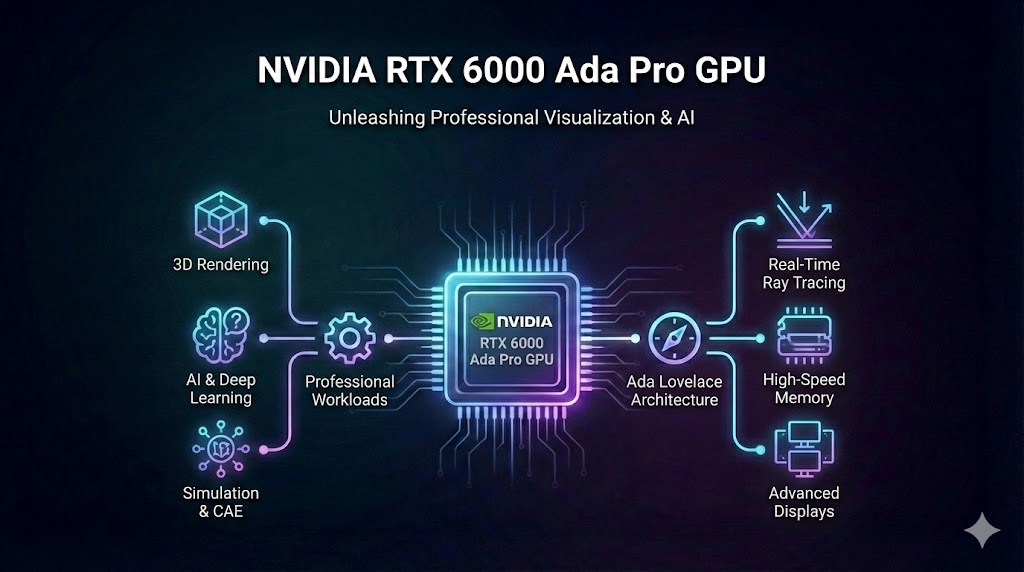
In a world where generative AI, real‑time rendering, and edge computing are redefining industries, the choice of GPU can make or break a project’s success. NVIDIA’s RTX 6000 Ada Generation GPU stands at the intersection of cutting‑edge hardware and enterprise reliability. This guide explores how the RTX 6000 Ada unlocks possibilities across AI research, 3D design, content creation and edge deployment, while offering a decision framework for choosing the right GPU and leveraging Clarifai’s compute orchestration for maximum impact.
The NVIDIA RTX 6000 Ada Generation GPU is the professional variant of the Ada Lovelace architecture, designed to handle the demanding requirements of AI and graphics professionals. With 18,176 CUDA cores, 568 fourth‑generation Tensor Cores, and 142 third‑generation RT Cores, the card delivers 91.1 TFLOPS of single‑precision (FP32) compute and an impressive 1,457 TOPS of AI performance. Each core generation introduces new capabilities: the RT cores provide 2× faster ray–triangle intersection, while the opacity micromap engine accelerates alpha testing by 2× and the displaced micro‑mesh unit allows a 10× faster bounding volume hierarchy (BVH) build with significantly reduced memory overhead.
Beyond raw compute, the card features 48 GB of ECC GDDR6 memory with 960 GB/s bandwidth. This memory pool, paired with enterprise drivers, ensures reliability for mission‑critical workloads. The GPU supports dual AV1 hardware encoders and virtualization via NVIDIA vGPU profiles, enabling multiple virtual workstations on a single card. Despite its prowess, the RTX 6000 Ada operates at a modest 300 W TDP, offering improved power efficiency over previous generations.
Choosing the right GPU involves understanding how generations improve. The RTX 6000 Ada sits between the previous RTX A6000 and the upcoming Blackwell generation.
|
GPU |
CUDA Cores |
Tensor Cores |
Memory |
FP32 Compute |
Power |
|
RTX 6000 Ada |
18,176 |
568 (4th‑gen) |
48 GB GDDR6 (ECC) |
91.1 TFLOPS |
300 W |
|
RTX A6000 |
10,752 |
336 |
48 GB GDDR6 |
39.7 TFLOPS |
300 W |
|
Quadro RTX 6000 |
4,608 |
576 (tensor) |
24 GB GDDR6 |
16.3 TFLOPS |
295 W |
|
RTX PRO 6000 Blackwell (expected) |
~20,480* |
next‑gen |
96 GB GDDR7 |
~126 TFLOPS FP32 |
TBA |
|
Blackwell Ultra |
dual‑die |
next‑gen |
288 GB HBM3e |
15 PFLOPS FP4 |
HPC target |
*Projected cores based on generational scaling; actual numbers may vary.
Benchmarking firms have shown that the RTX 6000 Ada provides a step‑change in performance. In ray‑traced rendering engines:
For video editing, the Ada GPU shines:
These improvements stem from the increased core counts, higher clock speeds, and architecture optimizations. However, the removal of NVLink means tasks needing more than 48 GB VRAM must adopt distributed workflows. The upcoming Blackwell generation promises even more compute with 96 GB memory and higher FP32 throughput, but release timelines may place it a year away.
Generative AI’s hunger for compute and memory makes GPU selection crucial. The RTX 6000 Ada’s 48 GB memory and robust tensor throughput enable training of large models and fast inference.
Generative AI models—especially foundation models—demand significant VRAM. Analysts note that tasks like fine‑tuning Stable Diffusion XL or 7‑billion‑parameter transformers require 24 GB to 48 GB of memory to avoid performance bottlenecks. Consumer GPUs with 24 GB VRAM may suffice for smaller models, but enterprise projects or experimentation with multiple models benefit from 48 GB or more. The RTX 6000 Ada strikes a balance by offering a single‑card solution with enough memory for most generative workloads while maintaining compatibility with workstation chassis and power budgets.
These cases illustrate how memory and compute scale with model size and emphasize the benefits of multi‑GPU configurations—even without NVLink. Adopting distributed data parallelism across cards allows researchers to handle massive datasets and large parameter counts.
The RTX 6000 Ada is also a powerhouse for designers and visualization experts. Its combination of RT and Tensor cores delivers real‑time performance for complex scenes, while virtualization and remote rendering open new workflows.
The card’s third‑gen RT cores accelerate ray–triangle intersection and handle procedural geometry with features like displaced micro‑mesh. This results in real‑time ray‑traced renders for architectural visualization, VFX and product design. The fourth‑gen Tensor cores accelerate AI denoising and super‑resolution, further improving image quality. According to remote‑rendering providers, the RTX 6000 Ada’s 142 RT cores and 568 Tensor cores enable photorealistic rendering with large textures and complex lighting. Additionally, the micro‑mesh engine reduces memory usage by storing micro‑geometry in compact form.
Remote rendering allows artists to work on lightweight devices while heavy scenes render on server‑grade GPUs. The RTX 6000 Ada supports virtual GPU (vGPU) profiles, letting multiple virtual workstations share a single card. Dual AV1 encoders enable streaming of high‑quality video outputs to multiple clients. This is particularly useful for design studios and broadcast companies implementing hybrid or fully remote workflows. While the lack of NVLink prevents memory pooling, virtualization can allocate discrete memory per user, and GPU fractioning (available through Clarifai) can subdivide VRAM for microservices.
Video editors, broadcasters and digital content creators benefit from the RTX 6000 Ada’s compute capabilities and encoding features.
The card’s high FP32 and Tensor throughput enhances editing timelines and accelerates effects such as noise reduction, color correction and complex transitions. Benchmarks show ~45 % faster DaVinci Resolve performance over the RTX A6000, enabling smoother scrubbing and real‑time playback of multiple 8K streams. In Adobe Premiere Pro, GPU‑accelerated effects execute up to 50 % faster; this includes warp stabilizer, lumetri color and AI‑powered auto‑reframing. These gains reduce export times and free up creative teams to focus on storytelling rather than waiting.
Dual AV1 hardware encoders allow the RTX 6000 Ada to stream multiple high‑quality feeds simultaneously, enabling 4K/8K HDR live broadcasts with lower bandwidth consumption. Virtualization means editing and streaming tasks can coexist on the same card or be partitioned across vGPU instances. For studios running 120+ hour editing sessions or live shows, ECC memory ensures stability and prevents corrupted frames, while professional drivers minimize unexpected crashes.
As industries adopt AI at the edge, the RTX 6000 Ada plays a key role in powering intelligent devices and remote work.
NVIDIA’s IGX platform brings the RTX 6000 Ada to harsh environments like factories and hospitals. The IGX‑SW 1.0 stack pairs the GPU with safety-certified frameworks (Holoscan, Metropolis, Isaac) and increases AI throughput to 1,705 TOPS—a seven‑fold boost over integrated solutions. This performance supports real‑time inference for robotics, medical imaging, patient monitoring and safety systems. Long‑term software support and hardware ruggedization ensure reliability.
Edge computing also extends to remote industries. In a maritime vision project, researchers deployed HP Z2 Mini workstations with RTX 6000 Ada GPUs to perform real‑time computer‑vision analysis on ships, enabling autonomous navigation and safety monitoring. The GPU’s power efficiency suits limited power budgets onboard vessels. Similarly, remote energy installations or construction sites benefit from on‑site AI that reduces reliance on cloud connectivity.
Virtualization allows multiple users to share a single RTX 6000 Ada via vGPU profiles. For example, a consulting firm uses mobile workstations running remote workstations on datacenter GPUs, giving clients hands‑on access to AI demos without shipping bulky hardware. GPU fractioning can subdivide VRAM among microservices, enabling concurrent inference tasks—particularly when managed through Clarifai’s platform.
With many GPUs on the market, selecting the right one requires balancing memory, compute, cost and power. Here’s a structured approach for decision makers:
|
Scenario |
Recommended GPU |
Rationale |
|
Fine‑tuning foundation models up to 7 B parameters |
RTX 6000 Ada |
48 GB VRAM supports large models; high tensor throughput accelerates training. |
|
Training >10 B models or extreme HPC workloads |
Upcoming Blackwell PRO 6000 / Blackwell Ultra |
96–288 GB memory and up to 15 PFLOPS compute future‑proof large‑scale AI. |
|
High‑end 3D rendering and VR design |
RTX 6000 Ada (single or dual) |
High RT/Tensor throughput; micro‑mesh reduces VRAM usage; virtualization available. |
|
Budget‑constrained AI research |
RTX A6000 (legacy) |
Adequate performance for many tasks; lower cost; but ~2× slower than Ada. |
|
Consumer or hobbyist deep learning |
RTX 4090 |
24 GB GDDR6X memory and high FP32 throughput; cost‑effective but lacks ECC and professional support. |
Clarifai is a leader in low‑code AI platform solutions. By integrating the RTX 6000 Ada with Clarifai’s compute orchestration and AI Runners, organizations can maximize GPU utilization while simplifying development.
Clarifai’s orchestration platform manages model training, fine‑tuning and inference across heterogeneous hardware—GPUs, CPUs, edge devices and cloud providers. It offers a low‑code pipeline builder that allows developers to assemble data processing and model‑evaluation steps visually. Key features include:
These features are particularly valuable when working with expensive GPUs like the RTX 6000 Ada. By scheduling training and inference jobs intelligently, Clarifai ensures that organizations only pay for the compute they need.
The AI Runners feature lets developers connect models running on local workstations or private servers to the Clarifai platform via a public API. This means data can remain on‑prem for privacy or compliance while still benefiting from Clarifai’s infrastructure and features like autoscaling and GPU fractioning. Developers can deploy local runners on machines equipped with RTX 6000 Ada GPUs, maintaining low latency and data sovereignty. When combined with Clarifai’s orchestration, AI Runners provide a hybrid deployment model: the heavy training might occur on on‑prem GPUs while inference runs on auto‑scaled cloud instances.
The AI and GPU landscape evolves quickly. Organizations should stay ahead by monitoring emerging trends:
The upcoming Blackwell GPU generation is expected to double memory and significantly increase compute throughput, with the PRO 6000 offering 96 GB GDDR7 and the Blackwell Ultra targeting HPC with 288 GB HBM3e and 15 PFLOPS FP4 compute. Planning a modular infrastructure allows easy integration of these GPUs when they become available, while still leveraging the RTX 6000 Ada today.
Multi‑modal models that integrate text, images, audio and video are becoming mainstream. Training such models requires significant VRAM and data pipelines. Likewise, agentic AI—systems that plan, reason and act autonomously—will demand sustained compute and robust orchestration. Platforms like Clarifai can abstract hardware management and ensure compute is available when needed.
Sustainability is a growing focus. Researchers are exploring low‑precision formats, dynamic voltage/frequency scaling, and AI‑powered cooling to reduce energy consumption. Offloading tasks to the edge via efficient GPUs like the RTX 6000 Ada reduces data center loads. Ethical AI considerations, including fairness and transparency, increasingly influence purchasing decisions.
The shortage of high‑quality data drives adoption of synthetic data generation, often running on GPUs, to augment training sets. Federated learning—training models across distributed devices without sharing raw data—requires orchestration across edge GPUs. These trends highlight the importance of flexible orchestration and local compute (e.g., via AI Runners).
Q1: Is the RTX 6000 Ada worth it over a consumer RTX 4090?
A: If you need 48 GB of ECC memory, professional driver stability and virtualization features, the RTX 6000 Ada justifies its premium. A 4090 offers strong compute for single‑user tasks but lacks ECC and may not support enterprise virtualization.
Q2: Can I pool VRAM across multiple RTX 6000 Ada cards?
A: Unlike previous generations, the RTX 6000 Ada does not support NVLink, so VRAM cannot be pooled. Multi‑GPU setups rely on data parallelism rather than unified memory.
Q3: How can I maximize GPU utilization?
A: Platforms like Clarifai allow GPU fractioning, batching and autoscaling. These features let you run multiple jobs on a single card and automatically scale up or down based on demand.
Q4: What are the power requirements?
A: Each RTX 6000 Ada draws up to 300 W; ensure your workstation has adequate power and cooling. Blower‑style cooling allows stacking multiple cards in one system.
Q5: Are the upcoming Blackwell GPUs compatible with my current setup?
A: Detailed specifications are pending, but Blackwell cards will likely require PCIe Gen5 slots and may have higher power consumption. Modular infrastructure and standards‑based orchestration platforms (like Clarifai) help future‑proof your investment.
The NVIDIA RTX 6000 Ada Generation GPU represents a pivotal step forward for professionals in AI research, 3D design, video production and edge computing. Its high compute throughput, large ECC memory and advanced ray‑tracing capabilities empower teams to tackle workloads that were once confined to high‑end data centers. However, hardware is only part of the equation. Integrating the RTX 6000 Ada with Clarifai’s compute orchestration unlocks new levels of efficiency and flexibility—allowing organizations to leverage on‑prem and cloud resources, manage costs, and future‑proof their AI infrastructure. As the AI landscape evolves toward multi‑modal models, agentic systems and sustainable computing, a combination of powerful GPUs and intelligent orchestration platforms will define the next era of innovation.